
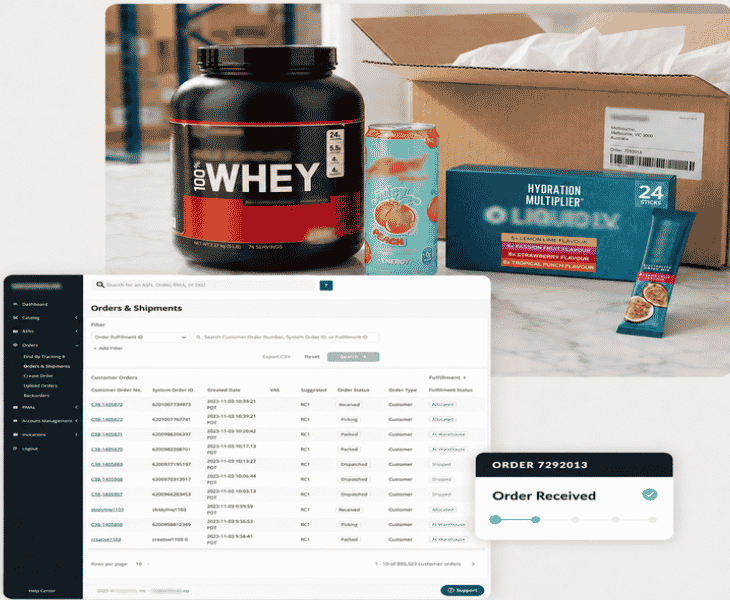
A Health And Wellness Brand Operating In Both B2C and B2B markets
This client is a health and wellness company specialising in energy drinks, hydration products, sports supplements and branded merchandise.
Their company operates two Shopify shops and fulfils small-batch wholesale carton orders and mixed-pallet B2B orders, whilst also offering repackaging and nationwide distribution across Australia.
As orders and sales channels have expanded, the existing back-end model has struggled to manage order structures, stock synchronisation, freight cost control and delivery timelines during peak seasons within a single workflow.
The Result
From modelling real-world business data to the coordination of orders, stock and delivery, CSG transforms complex B2C and B2B fulfilment into a measurable, scalable growth capability.
 AU$11,317 Cost-Effectiveness |  99.9% Dispatch accuracy rate |  22.7% Transport reduction |  35.67% Revenue increase |
A Unified Omnichannel Fulfilment Model is More Suitable for this Business Than a ‘Dual-Supplier Split’
The client initially considered having one supplier handle full-pallet distribution and another handle B2C and B2B fulfilment. Based on actual data, CSG concluded that this would increase the number of handover points between stock, orders, systems and carriers, making cost allocation and the definition of responsibilities more difficult; a unified model is better suited to their complex business mix.
B2C orders are frequent and dispersed; B2B orders are fewer in number, but the quantity of goods per order and the number of cartons picked are significantly higher. Products are also sold in a mix of single items, bundles, original cartons or repackaged orders, making it difficult for a single picking rule to cover all scenarios.
Frequent, dispersed B2C orders required different picking rules from lower-volume, multi-carton B2B orders, while 117,000 items across 107 SKUs and around eight monthly inbound deliveries were creating stocktake delays of up to three days. Shipping costs were spread across spreadsheets, invoices lacked order-level clarity, and two Shopify stores, MYOB and the internal ERP/API were disconnected.
Build Measurable, Interconnected & Scalable Omnichannel Fulfilment Systems
When receiving an enquiry from a client, Our fulfilment specialists first analyse the client’s actual business operations, then convert representative order, stock, goods-in, consignment and freight data into a comprehensive operational model.
The core of the solution is not to treat each order as a simple ‘box-moving’ task, but to establish a workable omnichannel 3PL system centred on the workflows of different channels.

CSG integrates warehousing, goods-in, ecommerce fulfilment, B2B carton picking, mixed pallets, repackaging and inventory management into a single operational view, whilst reducing process disconnects between multiple suppliers through standardised pick-and-pack workflow.

CSG uses representative monthly orders and consignment activities, stock information, inbound data, SKU dimensions and freight details to estimate operations for a full month. Customers can clearly see the cost structure for different order types and channels.

CSG offers plug-and-play integration with Shopify and, via an open API, supports MYOB or custom workflows to synchronise orders, stock levels and fulfilment status.
Standard system integration and API capabilities are included in the package, with no additional integration fees.

We have mapped out the operational procedures for inventory receipt , sorting, storage and order switching at our Melbourne 3PL warehousing, integrating the transfer of customers’ stock into the overall fulfilment plan to minimise the impact of the switch on ongoing dispatch operations.
VERIFIED BUSINESS OUTCOMES
CSG Reduces Costs and Supports Growth for Clients Through Five Verifiable Outcomes
Each of these five outcomes corresponds to specific operational actions and translates into tangible business value for clients—reducing current expenses while boosting their confidence in choosing a third-party logistics (3PL) provider and enhancing their capacity to handle peak-season demand.
-

Protecting Profits with Multi-Carrier Routes
CSG matches lower-cost routes to order structures and delivery requirements, reducing monthly shipping costs by 22.7% and alleviating the pressure that nationwide shipping costs place on profits for health drinks and supplements.
-

Fulfillment Supports Sales Surge
CSG supports increased sales volume during promotions with its scalable omnichannel fulfillment capabilities. During the client’s peak marketing season, when revenue rose by 35.67%, the company’s back-end warehousing and order processing capabilities helped drive even higher business growth.
-

Demonstrating the Economic Benefits of 3PL
After using CSG, the client monthly savings of AU$11,317 compared to their previous operating costs, with 3PL fulfillment costs reduced by at least 17.3%. The value of outsourcing 3PL was validated by quantifiable data, giving the client greater confidence in entrusting their fixed back-end operations to the 3PL.
-

Maintaining Accurate Deliveries in Peak Periods
CSG standardized its B2C picking, packing, and order processing workflows, achieving a 99.9% accuracy rate for consumer shipments during the first-quarter peak season. This reduced the impact of mis-shipments, re-shipments, and after-sales issues on customer experience and brand trust.
-

WMS Data to Support Replenishment and Marketing
CSG uses WMS to enhance visibility into inventory and sales, helping clients make faster decisions regarding replenishment, inventory allocation, and marketing priorities for the next quarter, while reducing the need for cross-sheet reconciliation and decision-making delays.
CSG VALUE
Builds a Sustainable Fulfilment Capabilities for Health Drink Brands
CSG does not merely manage warehouse operations; rather, it integrates the multi-channel orders, complex packaging combinations and system data typical of health drink brands with a nationwide distribution network, thereby transforming fulfilment from a passive cost centre into a back-end capability that supports sales growth.
- single inventory pool supports both B2C and B2B
Brands no longer need to maintain separate inventory and fulfilment systems for e-commerce, wholesale and mixed-pallet orders.
- Multi-variant orders processed under a unified set of rules
Single items, multi-packs, full cartons, mixed orders and repackaging requirements can all be incorporated into the same operational model.
- Data integration reduces manual reconciliation
Order, stock and fulfilment statuses are clearer, meaning sales, operations and accounts teams no longer need to rely on disparate spreadsheets for repeated verification.
- Multi-carrier Routing to Protect Profit Margins
When dealing with heavy, multi-box orders or those with different delivery address types, brands can control costs by selecting the most appropriate delivery options.
- Scalable Fulfilment to Support Marketing Growth
During promotional campaigns and peak seasons, warehousing, picking, packing and delivery capacities can scale in line with order growth.