As your brand grows, your fulfilment strategy becomes more important than ever.
Managing inventory, fulfilling orders quickly, and delivering a great customer experience all depend on having the right warehousing solution in place.
Many businesses use the terms warehouse and fulfilment centre interchangeably. While they may appear similar, they serve very different purposes.
Choosing the right solution can impact everything from storage costs and delivery speed to customer satisfaction and your ability to scale.
In this guide, CSG will explain the key differences between a traditional warehouse and a fulfilment centre, how each one works, and which option is best suited to your business.
What Is a Warehouse?

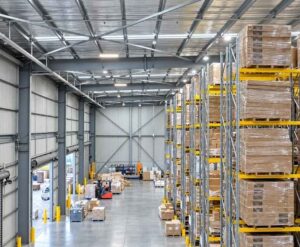
A warehouse is a facility primarily designed for the safe storage of inventory over the medium to long term.
Traditional warehousing is ideal for businesses that purchase products in bulk, maintain large inventory levels, or primarily supply wholesale customers.
A warehouse typically provides services such as:
- Receiving inbound goods
- Secure inventory storage
- Inventory management
- Pallet and bulk storage
- Stock tracking
- Distribution to wholesalers or retailers
The main objective of a warehouse is to keep inventory safe, organised and readily available when required. While some warehouses may offer basic order handling, they are generally not designed for processing high volumes of individual customer orders.
What Is a Fulfilment Centre?
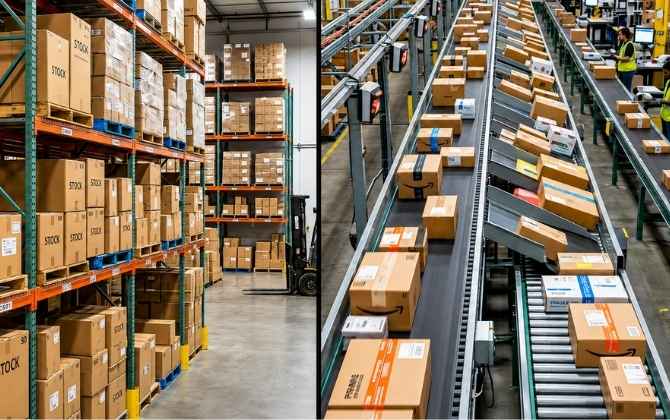
A fulfilment centre is a fast-moving logistics facility designed to process customer orders quickly and efficiently.
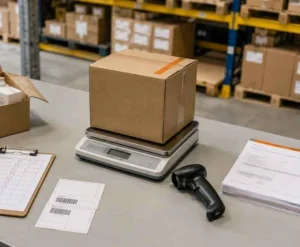
Rather than simply storing inventory, a fulfilment centre manages the complete order fulfilment process—from receiving products through to picking, packing, shipping and handling returns.
Inventory isn’t stored just to sit on shelves—it’s processed, picked, packed and dispatched as efficiently as possible.
Fulfilment centres are particularly well suited to:
- eCommerce brands
- Direct-to-consumer (D2C) businesses
- Multi-channel retailers
- Growing B2B brands
- Businesses with daily order fulfilment requirements
How Does a Fulfilment Centre Work?
A typical fulfilment process follows these steps:
- Inventory is received and inspected.
- Products are stored using a Warehouse Management System (WMS).
- Customer orders are automatically imported from platforms such as Shopify, WooCommerce or marketplaces.
- Warehouse staff accurately pick each order.
- Orders are professionally packed and labelled.
- Parcels are dispatched through trusted courier partners.
- Returns are received, inspected and processed when required.
The entire workflow is designed to minimise delays, reduce errors and deliver orders to customers as quickly as possible.
Warehouse vs Fulfilment Centre: What’s the Difference?
| Feature | Traditional Warehouse | 3PL Fulfilment Centre |
| Primary Purpose | Long-term inventory storage | Fast and accurate order fulfilment |
| Inventory Movement | Lower turnover | High inventory turnover |
| Main Operations | Bulk storage and pallet handling | Pick & Pack, shipping and returns |
| Technology | Basic inventory tracking | Integrated WMS, ERP and eCommerce platforms |
| Best For | Wholesale businesses, manufacturers and importers | eCommerce brands, D2C businesses and omnichannel retailers |
| Order Processing | Limited | High-volume daily fulfilment |
| Returns Handling | Usually limited | Fully managed returns process |
Simply put:
A warehouse stores your products. A fulfilment centre stores your products and fulfils your customer orders.
If your primary requirement is secure inventory storage, a warehouse may be all you need.
If you want faster shipping, improved customer satisfaction and a scalable logistics solution, a fulfilment centre is often the better choice.
Benefits of Traditional Warehousing
For businesses with stable inventory levels and predictable demand, traditional warehousing remains a cost-effective solution.
A warehouse may be the right choice if you:
- Hold large volumes of inventory
- Supply wholesale customers
- Ship full pallets or bulk orders
- Have relatively low daily order volumes
- Already manage your own packing and dispatch operations
Because warehousing focuses mainly on storage, operating costs are generally lower than a full-service fulfilment solution.
Benefits of a 3PL Fulfilment Centre
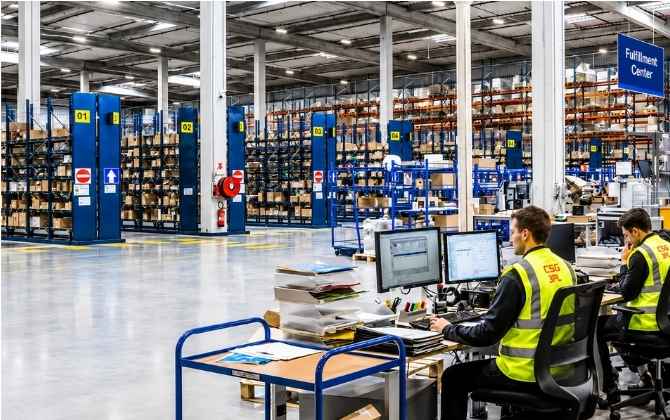
A third-party logistics (3PL) fulfilment provider offers much more than storage.
By outsourcing your fulfilment operations, your business gains access to experienced logistics professionals, established systems and scalable infrastructure—without the overhead of running your own warehouse.
Key benefits include:
- Faster order processing
- Professional Pick & Pack services
- Same-day dispatch where available
- Real-time inventory visibility
- Returns management
- Integration with Shopify, WooCommerce and other sales platforms
- Flexible capacity during peak seasons
- Reduced labour and warehouse management costs
Instead of spending valuable time managing logistics, your team can focus on growing your business, acquiring customers and developing new products.
Which Solution Is Right for Your Business?
The key difference between a warehouse and a fulfilment centre is the purpose of the facility. A warehouse is mainly designed to store and manage inventory, while a fulfilment centre is designed to process orders and move products to customers as quickly and accurately as possible.
A warehouse may be the right choice if your business:
- Stores inventory for medium or long periods
- Moves goods by pallet, carton, or bulk quantity
- Supplies retailers, distributors, commercial customers, or project sites
- Needs receiving, storage, stock control, and outbound handling
- Has its own sales, transport, or order management process
- Does not require daily pick, pack, and parcel shipping for individual consumers
In simple terms, a warehouse is best suited for businesses where inventory storage and bulk movement are the main operational needs.
A fulfilment centre may be the right choice if your business:
- Sells through eCommerce platforms or online marketplaces
- Receives regular DTC or B2C orders
- Needs individual items picked, packed, and shipped
- Manages multiple SKUs or sales channels
- Requires fast dispatch and accurate order processing
- Needs support with returns, exchanges, or branded packing
- Wants to scale without building an in-house warehouse and fulfilment team
Many growing businesses begin with traditional warehousing before transitioning to a 3PL fulfilment centre as order volumes increase and customer expectations continue to rise.
Why Growing Australian Brands Choose CSG 3PL
At CSG 3PL, we provide more than secure warehousing—we deliver complete fulfilment solutions designed to help businesses grow.
Whether you’re shipping wholesale pallet orders, eCommerce parcels or both, our experienced team supports every stage of the fulfilment process.
Our services include:
- Secure warehousing
- Inventory management
- Pick & Pack
- B2B and B2C order fulfilment
- Australia-wide distribution
- Returns management
- Flexible storage solutions
- Dedicated customer support
Frequently Asked Questions
1.Is a warehouse the same as a fulfilment centre?
No. A warehouse focuses primarily on storing inventory, while a fulfilment centre manages the complete order fulfilment process, including picking, packing, shipping and returns.
2.Which option is better for an eCommerce business?
For most eCommerce businesses, a fulfilment centre is the better choice because it offers faster order processing, platform integrations, professional Pick & Pack services and scalable operations.
3.Can a warehouse process customer orders?
Some warehouses offer limited order handling, but they are generally not designed for high-volume eCommerce fulfilment. Fulfilment centres specialise in processing large numbers of daily customer orders efficiently.
4.Does outsourcing fulfilment cost more?
Not necessarily. While fulfilment services include operational fees, many businesses reduce their overall logistics costs by avoiding warehouse leases, staffing, equipment purchases and ongoing operational expenses.
5.When should I move from warehousing to a fulfilment centre?
If your order volumes are growing, your team is spending more time packing orders, or your customers expect faster delivery, it may be the right time to partner with a professional 3PL fulfilment provider.
Ready to Scale Your Fulfilment?
As your business grows, your Fulfilment partner should grow with you.
Whether you need secure warehousing, high-volume eCommerce fulfilment, wholesale distribution or a combination of both, CSG 3PL can provide a flexible solution tailored to your business.
Our experienced team, advanced technology and scalable fulfilment services help Australian brands improve efficiency, reduce operational costs and deliver a better customer experience.
Contact CSG 3PL today to request a customised fulfilment quote and discover how we can help your brand grow faster.